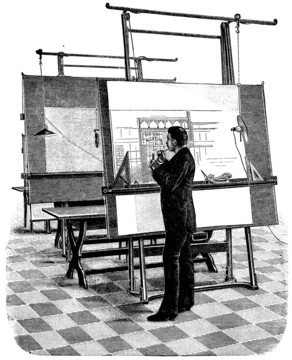
Balthasar Neumann
German architect and military engineer of the late Baroque.

via Wikipedia: Balthasar Neumann · see source
Johann Balthasar Neumann (c. 27 January 1687 – 19 August 1753), usually known as Balthasar Neumann, was a German architect and military engineer and one of the most important designers of late Baroque architecture in Central Europe. He developed a distinctive architectural style integrating Austrian, Bohemian, Italian, and French influences. His most notable works include the Würzburg Residence, described by UNESCO as one of the most important palaces of the High Baroque period, and the Basilica of the Fourteen Holy Helpers (Vierzehnheiligen), widely regarded as a masterpiece of German Baroque architecture.
- born
- c. 27 January 1687, Eger, Kingdom of Bohemia (now Cheb, Czech Republic)
- died
- 19 August 1753, Würzburg
- field
- Architecture, military engineering
- nationality
- German
- known_for
- Würzburg Residence, Basilica of the Fourteen Holy Helpers
Lore & Background
Neumann is believed to have been born on 27 January 1687 in Eger, Kingdom of Bohemia (now Cheb, Czech Republic), the seventh of nine children of cloth-maker Hans Christoph Neumann and his wife Rosina. He initially apprenticed at a bell and gun foundry in Eger, then traveled as a journeyman, arriving in Würzburg in 1711. In 1712 he began studying geometry, architecture and land surveying, and entered military service in the Würzburg artillery, where he remained until his death, ultimately attaining the rank of colonel. He participated in the Austro–Turkish War in 1717, advancing with his unit from Vienna to Belgrade, and in 1718 traveled through northern Italy studying architecture and briefly working on civilian construction projects in Milan. His career as an architect took off under Prince-Bishop Johann Philipp Franz von Schönborn, who in 1719 asked Neumann to plan, and in 1720 to lead construction of, the Würzburg Residence. Neumann traveled to France in 1723, meeting royal architects Germain Boffrand and Robert de Cotte in Paris and Versailles. He married Maria Eva Engelberts in 1725; the couple had eight children. Under Friedrich Karl von Schönborn, Neumann became director of all military, civil, and ecclesiastical construction in the bishoprics of Würzburg and Bamberg, and taught military and civilian architecture at Würzburg University from 1731. He designed numerous works including Schloss Bruchsal's monumental staircase, the Basilica of the Fourteen Holy Helpers (begun 1743), and the Abbey Church of Neresheim (begun 1747). He died in Würzburg on 19 August 1753 and was buried in the Marienkapelle there.
Reader's Guide
Balthasar Neumann's significance lies in his synthesis of Austrian, Bohemian, Italian, and French influences into a distinctive late Baroque style. His most celebrated work, the Würzburg Residence, is recognized by UNESCO as one of the most important High Baroque palaces. The Basilica of the Fourteen Holy Helpers is considered a masterpiece of German Baroque architecture, showcasing his use of centralized and rotunda-based spatial compositions. Neumann's career was shaped by the patronage of the Schönborn family, who entrusted him with major commissions across several bishoprics. He also served as a military engineer, overseeing fortifications, transport and water engineering, and urban planning. His legacy is commemorated on the German 50 Deutsche Mark banknote (1991–2002) and in Tiepolo's ceiling fresco at the Würzburg Residence, where Neumann is depicted in a pseudo-military uniform leaning over a cannon. His influence extended through his teaching at Würzburg University and his numerous architectural projects, though many plans, such as those for the Hofburg Palace in Vienna (after 1746), remained unrealized.
Did You Know?
- Neumann began his career as an apprentice at a bell and gun foundry in Eger.
- He served in the Würzburg artillery for his entire adult life, ultimately attaining the rank of colonel.
- Neumann participated in the Austro–Turkish War in 1717, advancing with his unit from Vienna to Belgrade.
- He is depicted in Giovanni Battista Tiepolo's ceiling fresco above the staircase of the Würzburg Residence, shown in a pseudo-military uniform leaning over a cannon.
- Neumann's portrait and the grand staircase of the Würzburg Residence appeared on the final German 50 Deutsche Mark banknote (issued 1991–2002).
From Foundry Apprentice to Imperial Architect
Born the seventh of nine children to cloth-maker Hans Christoph Neumann and his wife Rosina in Eger, Kingdom of Bohemia (now Cheb, Czech Republic), in early 1687, Johann Balthasar Neumann began his working life not in a drafting studio but at a bell and gun foundry. After a period of traveling as a journeyman, he settled in Würzburg in 1711, where he enrolled in studies of geometry, architecture, and land surveying. That same year he entered the Würzburg artillery, a military post he would hold for the rest of his life, eventually rising to the rank of colonel. His early technical output was remarkably practical: measurement instruments from 1712 and 1713, now in the Deutsches Museum in Munich and the Mainfränkisches Museum in Würzburg; a detailed map of Würzburg from 1715; and architectural drawings for a new abbey at Ebrach from 1716, now lost. In 1717 he saw active service during the Austro–Turkish War, marching with his unit from Vienna all the way to Belgrade. The following year he spent time in northern Italy, studying buildings and taking on small civilian construction work in Milan — experiences that would seed the eclectic vocabulary he later deployed across Franconia.
The Schönborn Patronage Machine
The Schönborn family was the engine behind Neumann's architectural career. In 1719, Prince-Bishop Johann Philipp Franz von Schönborn asked the young engineer to plan his new palace, and by 1720 Neumann was leading its construction — a project that would become his life's work. He followed this with the Schönborn Chapel in Würzburg Cathedral, begun in 1721, and, after a 1723 trip to Paris and Versailles where he consulted the royal architects Germain Boffrand and Robert de Cotte, a brief but unfinished hunting lodge at Mädelhofen begun in 1724 and demolished in 1725. When Friedrich Karl von Schönborn succeeded as Prince-Bishop of both Würzburg and Bamberg, he elevated Neumann to director of all military, civil, and ecclesiastical building across the two bishoprics. Neumann was summoned to Vienna in 1729 and again in 1739 to exchange ideas with Schönborn's court architect Johann Lukas von Hildebrandt. Beyond design, he oversaw fortifications, transport and water engineering, and urban planning, and from 1731 he taught both military and civilian architecture at Würzburg University.
A Synthesis of European Styles
Neumann's greatest contribution was forging a personal architectural language out of at least four distinct traditions. Austrian and Bohemian structural traditions — particularly the spatial ideas transmitted to Franconia through Johann Dientzenhofer — met Italian dynamism drawn from Guarino Guarini's centralized and rotunda-based compositions, while French spatial planning, absorbed during his 1723 Paris sojourn, added a new sense of axial grandeur. This synthesis is visible in the church at Kloster Holzkirchen, built between 1728 and 1730, where French spatial planning, Italian dynamism, and German Baroque structural traditions coexist in a single plan. It reaches its fullest expression in the Basilica of the Fourteen Holy Helpers at Vierzehnheiligen, begun in 1743, and the Abbey Church of Neresheim, begun in 1747, both celebrated as masterpieces of German Baroque architecture. His secular work carried the same eclecticism: the monumental staircase at Schloss Bruchsal (begun after 1731), the Dikasterialgebäude at Ehrenbreitstein Fortress (1739–1748), and the summer palace Schönbornslust at Kesselheim near Koblenz (1748–1752) all demonstrate how he could adapt his vocabulary to different patrons and sites across western Germany.
Enduring Legacy and Commemoration
Neumann died in Würzburg on 19 August 1753 and was interred in the Marienkapelle there. His two most celebrated works — the Würzburg Residence, which UNESCO has described as one of the most important palaces of the High Baroque period, and the Vierzehnheiligen basilica, widely regarded as a masterpiece of German Baroque architecture — continue to anchor the canon of Central European Baroque architecture. His face and the grand staircase he designed appeared together on the final German 50 Deutsche Mark banknote, issued between 1991 and 2002, a rare honour for an eighteenth-century builder. In Giovanni Battista Tiepolo's famous ceiling fresco above that very staircase, Neumann is depicted in a pseudo-military uniform leaning over a cannon, a visual nod to his lifelong artillery career. Several ambitious projects he proposed in his final years — a redesign of Vienna's Hofburg Palace (after 1746), plans for Stuttgart (after 1747), Schwetzingen Palace (1749), and the Karlsruhe Residence (after 1750) — were never built, yet the body of work he did complete, spanning fortifications, churches, palaces, and urban infrastructure, secured his reputation as a leading figure in late Baroque design across Central Europe.
Gallery
Frequently Asked Questions
Who is Balthasar Neumann?
He was a German architect and military engineer active in the early-to-mid 18th century, best remembered for his contributions to late Baroque design in Central Europe.
What is Balthasar Neumann's most famous building?
The Würzburg Residence stands as his signature achievement and is recognized by UNESCO as one of the great High Baroque palaces. His pilgrimage church at Vierzehnheiligen is also frequently cited as a pinnacle of German Baroque architecture.
What architectural style did Balthasar Neumann work in?
He practiced a late Baroque idiom that blended elements drawn from Austrian, Bohemian, Italian, and French traditions into a cohesive personal language.
Where was Balthasar Neumann born and where did he die?
He was born around 27 January 1687 in Eger (present-day Cheb, in the Czech Republic) and passed away on 19 August 1753 in Würzburg, Germany.
Why is Balthasar Neumann considered important in architectural history?
His ability to synthesize multiple national traditions into a unified Baroque vocabulary made him one of the defining figures of the style in Central Europe. His surviving works, particularly the Würzburg Residence and Vierzehnheiligen, remain benchmark examples of the period.
More in Architects 1-24
Spotted an error? Know more?
This is a living reference — every entry is fact-audited, and reader corrections feed straight into our audit queue. Suggest an edit · See this site's audit record